
The Internet is often described as a single global network – but in reality, it is anything but unified.
Behind every website you visit and every packet you send lies a vast ecosystem of independent networks, each operated by different organizations, from local Internet Service Providers to global technology giants. These networks don’t blindly cooperate. They follow their own rules, optimize their own traffic, and make independent decisions about how data should flow.
So how does the Internet actually work as a cohesive system?
The answer lies in a fundamental concept that is rarely explained clearly: Autonomous Systems (AS).
Rather than being one massive network, the Internet is a network of networks, structured into thousands of Autonomous Systems that coordinate traffic between them using a specialized protocol known as BGP. This architecture is not just a technical detail – it is one of the key mechanisms that allows the Internet to scale globally while remaining decentralized.

In this article, we’ll break down what an Autonomous System really is, why it exists, and how it enables the Internet to function across organizational boundaries – without losing control or flexibility.
In this article:
- The Internet Is Not One Network
- What Is an Autonomous System (AS)?
- Inside vs Outside: Two Different Routing Worlds
- Why BGP Exists (And Why It’s Not Just About Shortest Paths)
- A Real Journey Across the Internet
- References
1. The Internet Is Not One Network
At first glance, the Internet feels like a single, unified system. You type a URL, press Enter, and within milliseconds a response arrives – whether the server is across the street or on another continent. From a user’s perspective, everything appears seamlessly connected.
But this simplicity is an illusion.
In reality, the Internet is not one network. It is a vast collection of independent networks, each owned and operated by different organizations – Internet Service Providers (ISPs), cloud providers, universities, governments, and large enterprises. These networks are built using different technologies, follow different internal rules, and often have very different objectives.
This raises an important question:
How can thousands of independent networks, with no central authority, work together as if they were a single system?
The answer lies in how the Internet is structured.
A Network of Networks
The Internet is best understood as a “network of networks” – a layered ecosystem where smaller networks interconnect to form something much larger.
Each participating network:
- manages its own infrastructure,
- controls how traffic flows internally,
- and decides how to exchange traffic with other networks.
There is no global controller orchestrating everything. Instead, coordination emerges through agreed-upon protocols and conventions.
This decentralized model is not accidental – it is essential.
As explored in our article on scalability in computer networks, a flat, fully connected global network would be impossible to manage. Routing decisions would become unmanageable, configuration would not scale, and failures would propagate uncontrollably.
To make global connectivity feasible, the Internet must be structured, partitioned, and modular.
The Limits of Flat Routing
Imagine a world where every router on the Internet had to know how to reach every other network directly, without any form of grouping or hierarchy.
In such a system:
- routing tables would grow to enormous sizes,
- updates would propagate constantly across the entire Internet,
- and even small changes could create global instability.
This approach simply does not scale.
Instead, the Internet introduces a crucial abstraction: it groups networks into larger administrative domains that can be treated as single entities from the outside.
The Missing Piece
This is where the concept of Autonomous Systems comes in.
Rather than dealing with millions of individual routers or networks, the Internet operates at a higher level of abstraction:
- each group of networks is treated as a single unit,
- and interactions between these units follow well-defined rules.
This design allows the Internet to grow indefinitely while maintaining control, flexibility, and resilience.
In the next section, we’ll explore exactly what an Autonomous System is – and why this concept is fundamental to how the Internet really works.
2. What Is an Autonomous System (AS)?
Now that we understand the Internet is not a single network but a collection of many independent ones, we can introduce the key building block that makes this structure manageable: the Autonomous System (AS).
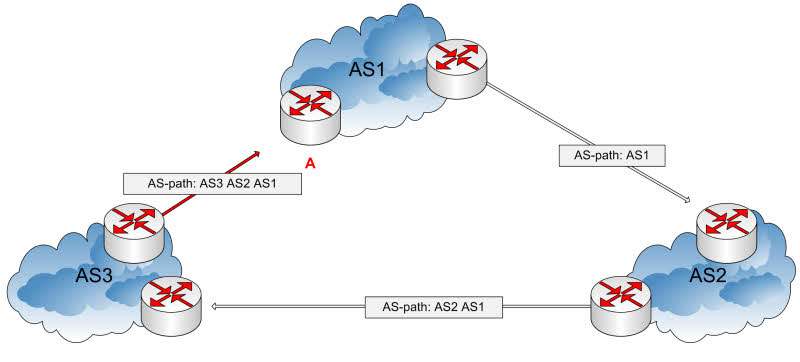
At its core, an Autonomous System is:
A group of IP networks and routers under the control of a single organization, presenting a common routing policy to the Internet.
This definition is technically accurate – but on its own, it doesn’t create real understanding. So let’s unpack it.
Thinking in Terms of Organizations
A more intuitive way to think about an Autonomous System is this:
An AS is a network operated as a single entity.
That entity could be:
- an Internet Service Provider (ISP),
- a large company like Google, Amazon, or Microsoft,
- a university network,
- or even a government infrastructure.
Each of these organizations:
- owns and manages its own network,
- decides how traffic flows internally,
- and defines how it connects to other networks.
From the outside, all of this complexity is hidden. The entire network behaves as a single unit.
One Identity, One Policy
Every Autonomous System has two defining characteristics:
1. A Unique Identifier (ASN)
Each AS is assigned an Autonomous System Number (ASN), which uniquely identifies it on the global Internet.
Think of the ASN as:
- a global ID,
- used by other networks to recognize and communicate with it.
2. A Consistent Routing Policy
More importantly, an AS defines a routing policy – a set of rules that determines:
- which routes it prefers,
- which traffic it accepts,
- and how it exchanges data with other networks.
This is a critical point.
Autonomous Systems are not just technical groupings – they are decision-making units.
Two networks may be physically similar but behave very differently depending on their policies.
Why Group Networks at All?
At this stage, you might ask:
Why not just treat every network individually?
The answer goes back to scalability.
By grouping routers and networks into Autonomous Systems:
- the Internet reduces complexity,
- limits the scope of routing decisions,
- and creates clear boundaries between administrative domains.
Instead of:
- millions of devices interacting directly,
we get:
- thousands of structured entities interacting in a controlled way.
An Analogy That Works
A useful analogy is to think of Autonomous Systems as countries in a global system.
- Inside a country:
- there are internal roads, rules, and infrastructure (internal routing).
- Between countries:
- there are borders, agreements, and policies (external routing).
Each country:
- governs itself,
- but must still cooperate with others to enable global movement.
The Internet works in much the same way.
From Concept to Practice
This abstraction—treating entire networks as single entities—is what makes large-scale coordination possible.
But it also creates a natural divide:
- What happens inside an Autonomous System?
- What happens between Autonomous Systems?
These are fundamentally different problems, solved using different approaches and protocols.
In the next section, we’ll explore this divide – and why routing inside a network is very different from routing across the Internet.
3. Inside vs Outside: Two Different Routing Worlds
Once networks are grouped into Autonomous Systems, a natural separation emerges – one that is essential to understanding how the Internet operates:
Routing inside an Autonomous System is fundamentally different from routing between Autonomous Systems.
These are not just two variations of the same problem. They are two distinct worlds, with different goals, constraints, and protocols.
Inside the Autonomous System: Efficiency and Performance
Within an Autonomous System, everything is under the control of a single organization. This changes the nature of the problem completely.
Here, the objective is straightforward:
Move traffic as efficiently and reliably as possible.
Since all routers belong to the same administrative domain:
- they can share detailed information,
- they trust each other,
- and they follow a common objective.
This environment allows for the use of Interior Gateway Protocols (IGPs) such as:
- OSPF (Open Shortest Path First)
- IS-IS (Intermediate System to Intermediate System)
These protocols are designed to:
- calculate the shortest or lowest-cost path through the network,
- quickly adapt to topology changes,
- and optimize overall performance.
In practice, this means:
- routing decisions are based on metrics like link cost or bandwidth,
- convergence is fast,
- and the system behaves like a well-coordinated machine.
Inside an AS, routing is a technical optimization problem.
Between Autonomous Systems: Policy and Control
Now step outside the boundaries of a single Autonomous System.
Suddenly, everything changes.
Each AS:
- is independently operated,
- has its own business interests,
- and does not fully trust other networks.
The goal is no longer just efficiency.
The goal is control.
This is where BGP (Border Gateway Protocol) comes in – the protocol that governs routing between Autonomous Systems (also known as inter-domain routing).
Why BGP Is Different
Unlike OSPF or IS-IS, BGP does not try to find the shortest path in a purely technical sense.
Instead, it allows each Autonomous System to:
- define its own routing policies,
- choose which routes to accept or reject,
- and decide how traffic should flow based on strategic considerations.
These decisions may include:
- preferring customer routes over peers,
- avoiding certain transit providers,
- or controlling outbound traffic for cost reasons.
In other words:
BGP is not just a routing protocol – it is a policy enforcement mechanism.
A Fundamental Contrast
We can summarize the difference like this:
| Aspect | Inside an AS (Intra-AS) | Between AS (Inter-AS) |
|---|---|---|
| Protocols | OSPF, IS-IS | BGP |
| Goal | Efficiency | Policy & control |
| Trust | High (same organization) | Low (independent networks) |
| Decision basis | Metrics (cost, latency) | Policies (business, strategy) |
| Scope | Local | Global |
Why This Separation Matters
This division between intra-AS and inter-AS routing is one of the key architectural principles of the Internet.
It allows:
- each organization to optimize its internal network independently,
- while still participating in a global system,
- without exposing internal complexity.
Without this separation:
- internal changes would ripple across the Internet,
- routing would become unstable,
- and scalability would break down.
The Bridge Between Worlds
Autonomous Systems don’t exist in isolation – they connect to each other through specialized routers known as border routers.
These routers:
- run internal protocols (like OSPF) to understand the local network,
- and run BGP to communicate with external networks.
They act as the bridge between two worlds:
- one focused on efficiency,
- the other on policy.
Understanding this distinction is crucial.
Because once you see it, you realize that the Internet is not just a technical system – it is a federation of independently managed networks, each balancing performance, control, and cooperation.
In the next section, we’ll take a deeper look at BGP and explore why it exists – and why the “shortest path” is often not the one that gets chosen.
4. Why BGP Exists (And Why It’s Not Just About Shortest Paths)
At this point, it’s tempting to think of routing as a purely technical problem:
Find the shortest path between two points and send the data that way.
That logic works perfectly inside an Autonomous System. But at the scale of the Internet, it breaks down completely.
To understand why BGP exists, we need to move beyond engineering – and into economics, control, and autonomy.
The Problem with “Shortest Path” Thinking
Imagine two different networks (two Autonomous Systems):
- One is your local ISP
- The other is a large global provider
Both may offer multiple possible paths to reach a destination.
From a purely technical perspective, one path might be:
- shorter,
- faster,
- or lower latency.
But from a business perspective, that same path might be:
- more expensive,
- less reliable contractually,
- or simply undesirable.
And here lies the key insight:
On the Internet, the “best” path is not always the shortest path.
Networks Are Independent – and Strategic
Each Autonomous System is operated by an organization with its own goals:
- ISPs want to maximize revenue and minimize costs
- Content providers want performance and control
- Enterprises want security and predictability
These goals don’t always align.
So when networks connect to each other, they don’t just exchange traffic – they establish relationships, such as:
- customer–provider (paid transit)
- peer-to-peer (mutual exchange, often settlement-free)
These relationships directly influence routing decisions.
BGP as a Policy Engine
This is exactly why BGP exists.
BGP allows each Autonomous System to enforce its own routing policy.
Instead of asking:
- “What is the shortest path?”
BGP asks:
- “What is the preferred path according to my rules?”
These rules can include:
- preferring routes learned from customers (revenue-generating),
- avoiding certain providers (cost control),
- prioritizing specific paths (performance or agreements),
- or filtering routes entirely (security or policy constraints).
Path Selection Is Not Neutral
When BGP evaluates multiple routes to the same destination, it does not simply pick the fastest one.
It evaluates a sequence of attributes, such as:
- local preference,
- AS path,
- origin,
- and other policy-driven factors.
This means:
Two different networks can choose completely different paths to reach the same destination.
And both are “correct” – because each is optimizing for its own objectives.
A System Built on Negotiation
A useful way to think about BGP is not as a routing protocol, but as a negotiation system between networks.
Each Autonomous System:
- advertises the routes it is willing to offer,
- evaluates the routes it receives,
- and makes independent decisions.
There is no central authority deciding how traffic should flow across the Internet.
Instead, global routing emerges from:
- thousands of local decisions,
- based on policies,
- shaped by business relationships.
Why This Design Works
At first glance, this may seem inefficient or overly complex.
But it is precisely this flexibility that makes the Internet scalable and resilient.
By allowing each network to:
- maintain control,
- define its own policies,
- and adapt independently,
the Internet avoids:
- centralized bottlenecks,
- rigid structures,
- and single points of failure.
This aligns directly with the broader principle of scalability discussed earlier: large systems must be decomposed into manageable, autonomous units.
The Trade-Off
Of course, this design comes with trade-offs:
- paths are not always optimal in terms of latency,
- routing can be harder to predict,
- and misconfigurations can have wide-reaching effects.
But the alternative – a globally optimized, centrally controlled routing system – is simply not viable at Internet scale.
The Big Picture
BGP exists because the Internet is not just a network – it is an ecosystem of independent actors.
It is the protocol that allows cooperation without central control.
And once you understand that, everything else starts to make sense:
- why routing paths look strange,
- why performance varies,
- and why the Internet behaves the way it does.
In the next section, we’ll bring all these concepts together by following a real packet as it travels across multiple Autonomous Systems.
5. A Real Journey Across the Internet
So far, we’ve built the conceptual framework:
- the Internet is a network of networks,
- those networks are organized into Autonomous Systems,
- and BGP coordinates routing between them based on policy.
Now let’s make this concrete.
What actually happens when you access a website?
From Your Device to the Global Internet
Imagine you open your browser and visit a website – let’s say a server hosted by a large cloud provider.
The journey begins inside your local network:
- your device sends a request,
- it reaches your home router,
- and is forwarded to your Internet Service Provider (ISP).
At this point, your data has entered its first Autonomous System.
Inside your ISP’s network:
- internal routing protocols (like OSPF or IS-IS) determine the best path,
- the packet is forwarded efficiently toward the edge of the ISP.
So far, everything is happening within a single AS – controlled, optimized, predictable.
Crossing Autonomous System Boundaries
Eventually, your ISP needs to send that traffic beyond its own network.
This is where things change.
At the edge of the ISP, a border router uses BGP to decide:
- which external network should receive the traffic,
- based on available routes and local policies.
Your packet is then handed off to another Autonomous System – perhaps:
- a regional provider,
- a large transit network,
- or directly to a content provider’s infrastructure.
Each transition like this is called an AS hop.
A Chain of Independent Decisions
As your packet moves across the Internet, it may pass through several Autonomous Systems:
- Your local ISP
- A national or regional provider
- A global backbone network
- The destination network (e.g., a cloud provider)
At each step:
- the receiving AS evaluates available routes using BGP,
- applies its own policies,
- and decides where to send the packet next.
There is no single entity controlling the full path.
The route emerges from a sequence of independent decisions.
The AS Path
One of the key pieces of information used in BGP is the AS path:
- a list of Autonomous Systems that a route has traversed.
For example, a route might look like:
AS64500 → AS3356 → AS15169
This tells a network:
- where the traffic has been,
- and indirectly, how to reach the destination.
The AS path is not just informational – it also influences decisions:
- shorter paths may be preferred,
- but only if they align with policy.
Not Always the Shortest Route
Here’s where theory meets reality.
Even if a shorter path exists, your traffic might not take it.
Why?
Because each Autonomous System is optimizing for its own goals:
- minimizing cost,
- respecting agreements,
- balancing load,
- or enforcing security constraints.
This means:
- your data might take a longer geographical route,
- pass through unexpected regions,
- or avoid certain networks entirely.
And yet, from your perspective, everything still “just works.”
The Return Journey
The response from the server follows a similar process – but not necessarily the same path.
Because routing decisions are made independently:
- the forward path and return path can be different.
This is known as asymmetric routing, and it is completely normal on the Internet.
Bringing It All Together
What looks like a simple request from your browser is, in reality:
- a journey across multiple Autonomous Systems,
- coordinated by BGP,
- shaped by policy, not just physics,
- and executed without any central control.
And yet, it works – at a global scale.
The Hidden Architecture of the Internet
This journey reveals something fundamental:
The Internet is not a monolithic system – it is a cooperative structure of independent networks.
Autonomous Systems provide the structure.
BGP provides the coordination.
Together, they make it possible for:
- billions of devices,
- across thousands of networks,
- to communicate seamlessly.
Understanding this architecture changes how you see the Internet.
It is no longer just a technical system – it is a dynamic, decentralized ecosystem where engineering, policy, and economics intersect to keep the world connected.
6. References
The concepts presented in this article are grounded in well-established principles of computer networking, particularly in the areas of Internet architecture, inter-domain routing, and protocol design. The following resources provide deeper insights into Autonomous Systems, BGP, and the structure of the Internet.
Foundational Textbooks
- Kurose, J. F., & Ross, K. W.
Computer Networking: A Top-Down Approach (8th Edition)
Pearson
A widely used reference that explains the Internet as a “network of networks” and introduces BGP and inter-domain routing with strong conceptual clarity. - Peterson, L. L., & Davie, B. S.
Computer Networks: A Systems Approach (6th Edition)
Morgan Kaufmann
Provides a more architectural and systems-oriented perspective on networking, including routing scalability and the role of administrative domains.
Standards and Technical Documents
- Internet Engineering Task Force (IETF)
RFC 4271 – A Border Gateway Protocol 4 (BGP-4)
https://datatracker.ietf.org/doc/html/rfc4271
The official specification of BGP, detailing how inter-domain routing is implemented across Autonomous Systems. - Internet Engineering Task Force (IETF)
RFC 1930 – Guidelines for Creation, Selection, and Registration of an Autonomous System (AS)
https://datatracker.ietf.org/doc/html/rfc1930
Defines the concept of Autonomous Systems and provides guidance on ASN allocation.
Online Resources and Learning Platforms
- Cisco Systems Documentation
https://www.cisco.com
Practical explanations of BGP, AS design, and real-world routing policies used in enterprise and service provider networks. - Cloudflare Learning Center
https://www.cloudflare.com/learning/
Accessible and well-structured articles explaining how BGP and Autonomous Systems work in practice. - RIPE NCC Documentation
https://www.ripe.net
Authoritative source for information on AS numbers, IP allocation, and operational practices in Europe.
Conceptual and Economic Perspectives
- Gao, L. (2001)
On Inferring Autonomous System Relationships in the Internet
IEEE/ACM Transactions on Networking
A seminal paper exploring how business relationships (customer–provider, peering) influence BGP routing decisions. - Varian, H. R., Shapiro, C. (1999)
Information Rules: A Strategic Guide to the Network Economy
Harvard Business School Press
While not specific to networking protocols, this work provides useful context for understanding the economic forces shaping Internet infrastructure.
Related Article
- What “Scalability” Really Means in Computer Networking
https://networkencyclopedia.com/what-scalability-really-means-in-computer-networking/
This article explores the broader concept of scalability and provides the conceptual foundation for understanding why structures like Autonomous Systems are necessary.