A server receives 1,000 messages per second. Its worker can process 600. Someone suggests a larger queue.
For a few seconds, the problem seems solved. Then the queue fills, response times rise, and the system discovers that memory is a waiting room, not an extra employee.
Backpressure in networking is feedback that makes an upstream producer reduce or pause its output when a downstream component cannot keep up. Instead of letting every stage accept more work indefinitely, the system communicates its limits. [1]
That feedback can appear in a transport protocol, an Ethernet link, or an application pipeline. The mechanisms differ. The question is the same: what makes the sender notice that the receiver is falling behind?
What Is Backpressure in Networking?
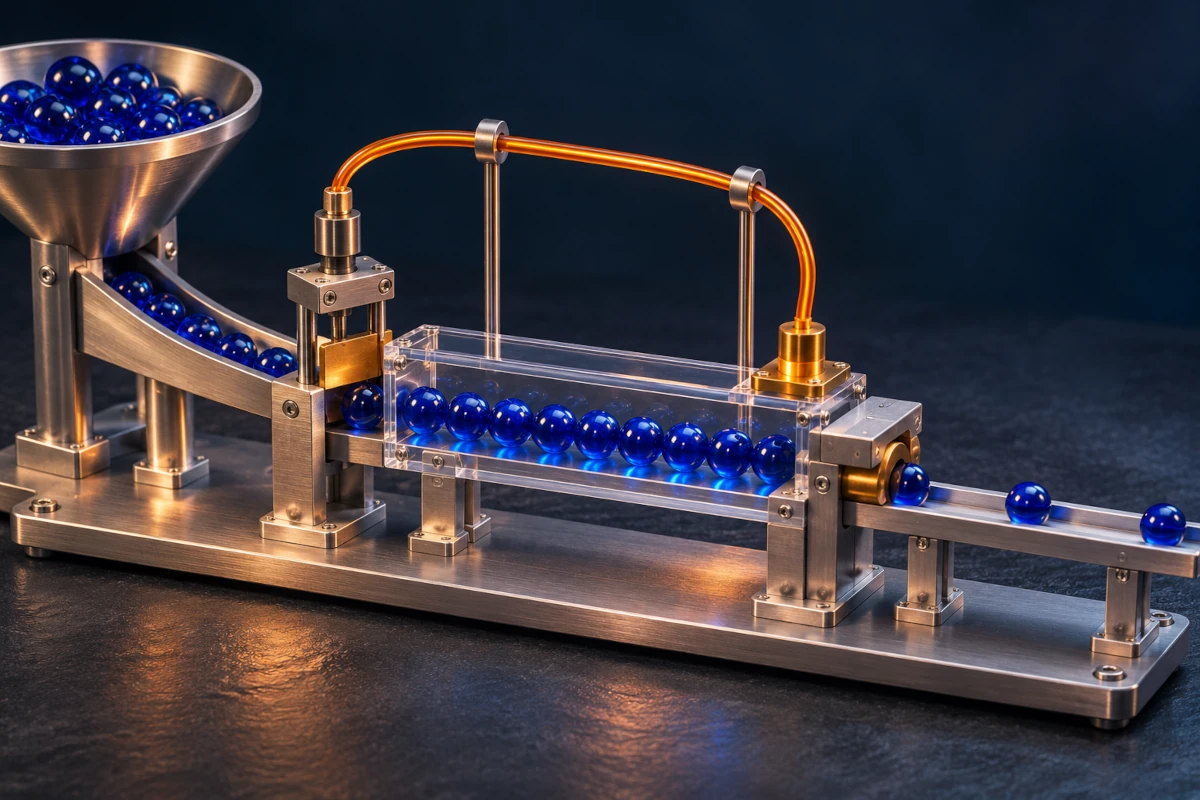
Picture a conveyor feeding parcels into a packing station. A small holding area absorbs occasional bursts. When it approaches capacity, a sensor tells the upstream feeder to slow down. Once space returns, feeding can resume.
The holding area is the buffer. The return signal and the feeder’s response create backpressure.
Without that response, the holding area merely postpones the moment when parcels must be dropped, rejected, or stored somewhere else. A bounded queue helps only if producers respect its capacity and the rest of the system handles the resulting wait or refusal.
Backpressure is a feedback pattern, rather than one universal networking protocol. Reactive Streams, for example, explicitly uses downstream demand to regulate asynchronous data exchange and keep resource consumption bounded. [1]
The Five-Second Queue
Return to our fictional server. Assume steady rates, equal-sized messages, an initially empty waiting queue, and no scheduling or bookkeeping overhead:
| Quantity | Illustrative value |
|---|---|
| Incoming rate | 1,000 messages/second |
| Processing capacity | 600 messages/second |
| Backlog growth | 400 messages/second |
| Waiting-queue capacity | 2,000 messages |
| Approximate time to fill | 5 seconds |
The calculation is straightforward:
Backlog growth = 1,000 - 600 = 400 messages/second
Time to fill = 2,000 / 400 = 5 seconds
Doubling the buffer buys roughly another five seconds under these assumptions. It does not turn the worker into a 1,000-message-per-second service.
There is a second number worth noticing. Clearing a 2,000-message backlog would take roughly 2,000 / 600 = 3.33 seconds at that constant processing rate, if no new messages joined it. Time until a queue fills and time needed to clear an existing backlog are different measurements.
These are calculated illustrations, not server benchmarks. Real workloads have bursts, variable message sizes, and changing processing costs.
With effective backpressure, the accepted input must adjust to sustainable downstream capacity. If the original source cannot slow down, the design needs another deliberate response: reject or discard some work, change the workload, or add capacity. Moving the backlog to an unlimited upstream queue simply relocates the problem.
Backpressure, Buffering, and Other Related Terms
These ideas overlap, but they answer different questions:
| Mechanism or concept | Main question |
|---|---|
| Buffering | Where can a temporary backlog wait? |
| Backpressure | How does limited downstream capacity affect upstream production? |
| Flow control | How can a sender avoid overwhelming a receiver? |
| Congestion control | How should traffic adapt to capacity and contention along the network path? |
| Rate limiting | How much traffic is permitted under a configured policy? |
| Load shedding | Which work should be refused or discarded when it cannot be served acceptably? |
Our flow-control overview introduces receiver protection. Flow-control mechanisms can carry backpressure, while congestion control addresses the broader path. A fixed rate limit may help, but it does not necessarily react to a consumer whose capacity changes.
The practical test is to trace the feedback: what detects pressure, what signal travels upstream, and which producer actually changes its behavior?
How TCP Carries Receiver Pressure Upstream
TCP includes a receive-window mechanism. The receiver advertises how much additional sequence-space data it is prepared to accept. As available receive-buffer space becomes constrained, that advertised window can limit the sender; a zero window stops ordinary new data transmission while the connection can still exchange control traffic. [2]
This is distinct from TCP’s congestion window, which limits outstanding data according to the sender’s congestion-control behavior. Transmission must respect both constraints, among others. A large receive window does not override a restrictive congestion window, and the reverse is also true. [3]
Now imagine a server whose database slows down. If the application eventually stops draining its TCP receive buffers, pressure can reach the remote sender through flow control.
But suppose the application keeps reading the socket and placing every message into an unlimited in-memory work queue. The transport buffers remain available while the application backlog grows. TCP cannot infer that those messages still await database processing.
A TCP acknowledgment means bytes have been accepted by the receiving TCP implementation. It does not mean that an order has been processed or a database transaction committed. Application-level completion needs its own meaning. [2]
Ethernet PAUSE Is a Different Mechanism
On a full-duplex Ethernet link, IEEE 802.3x PAUSE can ask a directly connected peer to suspend ordinary frame transmission temporarily. This is link-level flow control, rather than a signal addressed directly to every application producing the traffic. [4]
Priority-based Flow Control (PFC) applies a related mechanism to selected traffic priorities instead of pausing all ordinary traffic on the link. It is associated with carefully engineered data-center environments. A priority class can contain multiple flows; PFC is not automatically per-flow isolation. [5]
Pausing upstream transmission can also move congestion toward other queues or delay unrelated traffic sharing the affected resources. IEEE’s congestion-isolation work addresses, among other things, head-of-line blocking between flows sharing a traffic class in lossless networks. [6]
That is why “enable flow control everywhere” is an inadequate design rule. The scope of the pause, buffer headroom, traffic classes, and topology all matter.
One terminology wrinkle: some switch interfaces use Back Pressure specifically for older half-duplex, collision-based congestion behavior. Cisco documents that feature separately from full-duplex 802.3x flow control. That narrower equipment setting is not the whole meaning of backpressure used in this article. [7]
Application Backpressure: The Consumer Must Get a Vote
A streaming application can express downstream capacity directly: request another batch, grant credits, or suspend an upstream task until space becomes available.
In Python, an asyncio.Queue with a positive maxsize makes await put() wait when the queue is full. A consumer removing an item opens a slot. Notice that this limits waiting items, not necessarily all work currently being processed or all memory used by the program. [8]
For network output, Python’s asyncio stream interface provides a flow-control point:
writer.write(data)
await writer.drain()
This is an API fragment inside an asynchronous function with an existing connected writer. It is not a standalone program. drain() cooperates with the transport’s write-buffer watermarks; it is not confirmation that the remote application completed the work. [9]
The same principle appears in other ecosystems. Node.js documents how stream producers must respect downstream write signals rather than continuing to queue data without limit. [10]
Asynchronous execution does not create unlimited processing capacity. Backpressure works when the producer awaits or otherwise honors the capacity signal. Launching thousands of independent tasks that all wait to enqueue can still create a large backlog outside the queue you bounded.
Why the Feedback Must Arrive Before the Buffer Is Full
An upstream sender cannot react before it receives the signal. Meanwhile, data already transmitted can still arrive.
A practical design therefore needs headroom for in-flight data, feedback and reaction delay, and bursts. High and low watermarks can let a producer pause before exhaustion and resume after enough space returns, rather than oscillating around one threshold. Python’s stream documentation describes this high/low-watermark behavior for drain(). [9]
Our bandwidth-delay product guide explains why a path can contain substantial outstanding data. That quantity helps explain feedback delay, but does not, by itself, prescribe the right router-buffer size.
For applications, count bytes and active work as well as queue entries. A limit of 100 objects is not a useful memory guarantee if each object can contain an enormous payload.
Backpressure Does Not Mean “Never Drop Anything”
An Internet router cannot make every source obey a link-level pause across the whole path. Active Queue Management (AQM) can drop packets or mark ECN-capable traffic before a standing queue becomes excessive, giving responsive congestion-control mechanisms a chance to react. [11]
That is a different control loop from an Ethernet PAUSE request. Our bufferbloat troubleshooting guide explains why keeping useful throughput and controlling queue delay must be considered together.
UDP itself supplies neither TCP-style receive windows nor inherent congestion control. Applications and protocols built on UDP need appropriate mechanisms for their use case; choosing UDP does not remove the need to manage offered traffic and receiver capacity. RFC 8085 provides the relevant design guidance. [12]
Sometimes rejection is the correct outcome. A request that expires after sitting in a huge queue may be less useful than an early refusal that the caller can handle according to the application’s retry policy.
What to Measure When a System Slows Down
Start with the relationship between offered, accepted, and completed work. A lower accepted rate is not automatically a failure: it may be the system protecting itself from overload.
Then investigate:
- Queue occupancy and age: how much is waiting, and how long has the oldest work waited?
- Producer waiting: where do writes, enqueue operations, or credit requests pause?
- Rejections and drops: is overload handled explicitly, or hidden behind timeouts?
- Backlog outside the obvious queue: inspect transport buffers, pending tasks, and upstream stages.
- Recovery: when the consumer catches up, does production resume and does the backlog drain?
The important question is where the pressure stops propagating. A downstream component may signal capacity correctly while an intermediate component absorbs the signal into another growing queue.
A Useful “Slow Down” Is Part of Reliability
Backpressure in networking turns limited capacity into information that upstream components can act on. It helps make overload visible before waiting work consumes every available resource.
The system still needs capacity planning, bounded storage, and a policy for work that cannot wait. Feedback cannot manufacture processing power.
The packing station can take a short breath. It should not need a larger warehouse every time it does.
References and Further Reading
- Reactive Streams: Goals and Backpressure Model.
- RFC 9293: Transmission Control Protocol—receive windows and acknowledgment semantics.
- RFC 5681: TCP Congestion Control.
- Cisco: Ethernet Flow Control.
- IEEE 802.1Qbb: Priority-based Flow Control.
- IEEE 802.1Qcz: Congestion Isolation.
- Cisco: Half-Duplex Back Pressure and Full-Duplex Flow Control.
- Python Documentation: asyncio Queues.
- Python Documentation: asyncio Streams.
- Node.js: Backpressuring in Streams.
- RFC 7567: Active Queue Management Recommendations.
- RFC 8085: UDP Usage Guidelines.