
Imagine unveiling a new computer network and announcing that a message might disappear, arrive twice, or turn up after the message sent behind it. The sales presentation would be a difficult one.
Yet a French research project in the 1970s helped demonstrate why accepting those possibilities could be a powerful engineering choice. The CYCLADES network, led by Louis Pouzin, separated the task of moving packets from the task of making a conversation reliable.
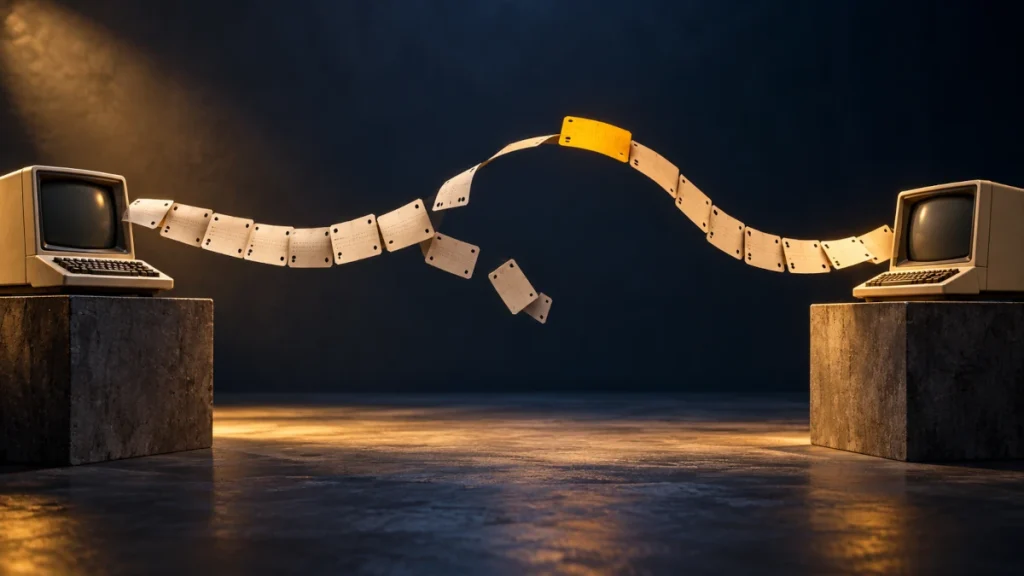
The network would carry messages. The computers at its edges would check what had actually arrived and recover when necessary. That division of responsibility helped shape the Internet—and explains why your downloads can be reliable even though individual IP packets are not guaranteed to arrive.
France’s other contribution to the Internet story
The familiar story begins with ARPANET. But networking research was an international conversation, with important work in Britain, France, and elsewhere.
CYCLADES began in 1972 at IRIA, the French research institute in Rocquencourt. Its objective was practical as well as experimental: connect different kinds of computers at research institutions and explore services such as access to distributed databases. Pouzin’s contemporary design paper describes a layered architecture intended to accommodate different machines and evolving requirements.
By November 1973, a small network was being demonstrated publicly, with facilities including file transfer and remote job submission. This was working engineering, with software to implement and machines to connect, rather than a proposal waiting for perfect hardware.
Its most interesting question was deceptively simple: how much should the network promise?
Meet CIGALE, the carrier inside CYCLADES
Two names matter here. CYCLADES was the wider computer-network project. CIGALE was its packet-switching subnetwork: the machinery that carried messages between attached computers.
In his 1974 CIGALE paper, Pouzin described independent messages handled much like letters in the post. The carrier did not provide the complete end-to-end conversation; higher-level protocols could supply the functions the communicating computers required.
CIGALE did check and acknowledge packets between neighboring nodes. But node or line failures could still lose or duplicate a packet. Local protection therefore did not remove the need for checks between the communicating hosts.
This is the essential idea behind a datagram service. A message carries addressing information and is forwarded without first establishing a virtual circuit for that conversation. The service does not promise that messages will arrive in order, exactly once, or at all.
Independent handling does not mean every packet must follow a different route. It means the service does not depend on a previously established per-conversation circuit. Different packets can still take the same path.
If packet switching explains how traffic shares links, CYCLADES poses a further question: which layer should repair a conversation when that shared transport fails?
A missing postcard does not have to ruin the conversation
Imagine sending three numbered pieces of a message: 1, 2, and 3. The receiver gets 3, then 1. Piece 2 never appears.
A reliable protocol at the endpoints can track sequence information, acknowledge progress, detect missing data, and arrange retransmission. Once the missing information arrives, it can present the data in the required order.
The network has not become infallible. The complete system has learned to cope with an imperfect carrier.
| What happens during transit | What an endpoint reliability mechanism can do |
|---|---|
| A piece goes missing | Detect the gap or lack of progress and trigger retransmission. |
| Pieces arrive out of order | Track their positions and restore the required order. |
| A piece arrives twice | Recognize the duplicate and avoid delivering its contents twice. |
| Communication cannot recover | Report a failure instead of pretending the transfer succeeded. |
This is a simplified teaching example, not a reconstruction of the CYCLADES wire protocol. The same division of work is visible in modern TCP/IP: IP transports datagrams, while TCP uses endpoint mechanisms to provide an ordered, reliable byte stream.
TCP’s sequencing, acknowledgments, error detection, and retransmissions do not make successful delivery inevitable. A permanent outage or a failed host can still end a connection. Reliability means detecting and recovering from specified problems where possible, with failure remaining a real outcome.
Why a smaller promise can make a bigger network possible
The difficult ambition was to connect networks with different characteristics. A design tied to one carrier’s particular delivery guarantees would make that job harder.
A limited common service offers a useful boundary: carry an addressed datagram, then let the endpoints implement the additional behavior their communication needs. One network’s internal design need not become the mandatory design for every other network.
That does not make routers simple in every sense, or forbid error recovery inside individual links. It establishes a boundary between the service the network offers and the complete result an application needs.
The distinction remains explicit in RFC 791, the 1981 IPv4 specification: IP does not itself supply end-to-end reliability or sequencing. The document also allows IP to benefit from the services of the networks underneath it.
Best effort is therefore compatible with careful engineering. A network can work hard to deliver packets while acknowledging that it cannot promise success in every circumstance.
The clue is in the acknowledgments
Historical influence is easier to assess when the original documents leave a trail.
Vinton Cerf and Robert Kahn’s 1974 paper, A Protocol for Packet Network Intercommunication, describes an architecture for communication across different packet networks. Its acknowledgments include Louis Pouzin and other researchers who contributed ideas and criticism.
That is a better picture than a lone inventor handing the world a finished Internet. CYCLADES contributed to an exchange of designs, experiments, and arguments among research groups. Cerf and Kahn’s work was not simply CYCLADES with a different name, and the modern separation between TCP and IP developed over time.
The Internet Society’s Internet Hall of Fame profile of Pouzin recognizes the importance of CYCLADES and its datagram network to that history.
A reliable link still cannot prove your file is safe
The architectural question became broader than packet delivery. Saltzer, Reed, and Clark’s End-to-End Arguments in System Design, published in journal form in 1984, examined where functions belong in a distributed system.
Consider a file transfer. Even if every network link handles transmission errors well, the complete operation can still fail elsewhere: while reading the source, copying data through software, or storing the result. Verifying the finished transfer requires checks at the appropriate endpoints.
The argument does not say that lower-level checks are useless. They can improve performance and reduce the frequency of expensive recovery. It says that those checks cannot, by themselves, establish every property the application cares about.
A TCP acknowledgment, for example, does not prove that a server has safely committed an uploaded document to storage. The application needs its own definition of completion.
CYCLADES had explored an important instance of this broader design question years earlier: place responsibility where the system has enough information to fulfill it.
The network also needed a human protocol
One of the most delightful details is tucked inside Pouzin’s 1975 project report.
The participants were spread across institutions. Instead of relying entirely on a rigid administrative hierarchy, the project encouraged initiative, mixed teams, and informal communication. Someone from IRIA was specifically assigned to travel between groups and circulate information—a role Pouzin called a “gossip carrier.”
The packet network needed messages to move between computers. Building it required knowledge to move between people. Some coordination problems remain remarkably familiar.
The idea worth remembering
CYCLADES makes Internet history useful because its central question is still an engineering question: who can actually tell whether the job is complete?
A router can forward a packet. A transport protocol can track the delivery of bytes. An application can decide whether the intended operation succeeded. Those responsibilities are related, but they are not interchangeable.
The French experiment helped show how an imperfect carrier could support reliable communication. Its enduring achievement was a carefully chosen place to put responsibility.
Sources and further reading
- Louis Pouzin, Presentation and Major Design Aspects of the CYCLADES Computer Network, 1973 presentation, reproduced in later proceedings.
- Louis Pouzin, CIGALE, the Packet Switching Machine of the CYCLADES Computer Network, IFIP Congress, 1974.
- Louis Pouzin, The CYCLADES Network—Present State and Development Trends, 1975.
- Vinton G. Cerf and Robert E. Kahn, A Protocol for Packet Network Intercommunication, IEEE Transactions on Communications, May 1974.
- J. H. Saltzer, D. P. Reed, and D. D. Clark, End-to-End Arguments in System Design, ACM Transactions on Computer Systems, November 1984.
- RFC 791: Internet Protocol, 1981; RFC 9293: Transmission Control Protocol, 2022.