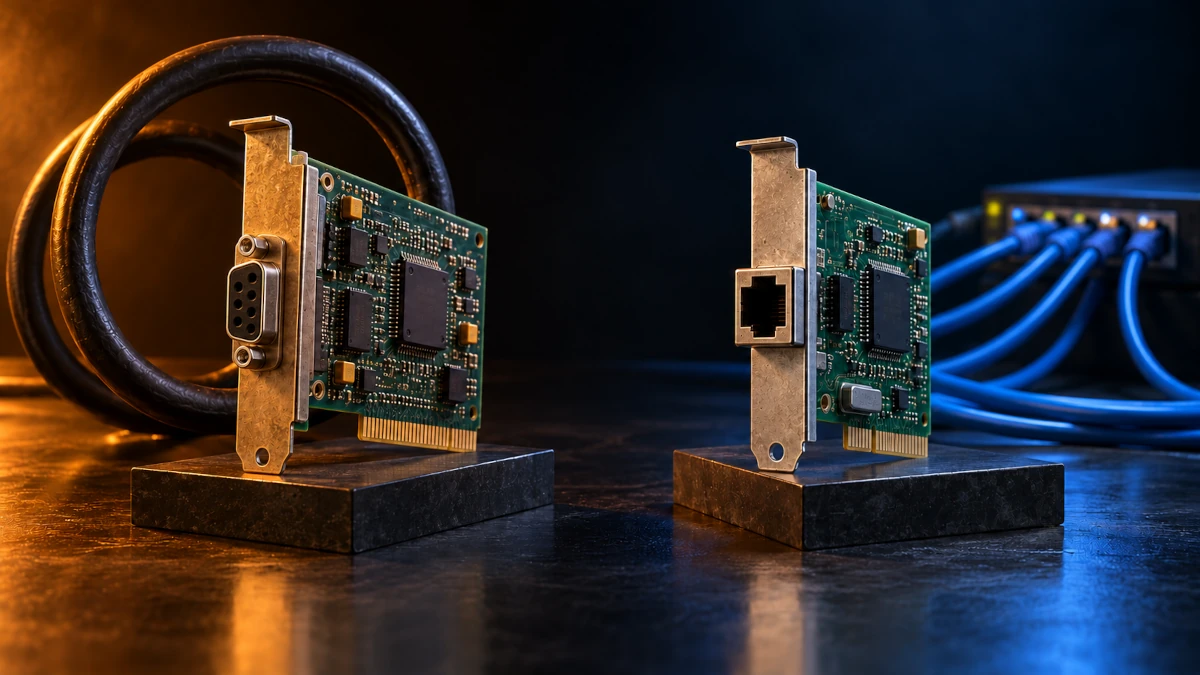
Imagine choosing an office network in the late 1980s. One contender lets computers transmit when the shared cable seems quiet, then sorts out collisions if two speak together. The other hands out permission using a circulating token. One sounds like a busy conversation; the other sounds like a meeting with a very disciplined chairperson.
Which would you trust with your company’s data?
For many organizations, Token Ring was a sensible answer. Yet Ethernet became the default for wired LANs. The explanation is more interesting than “the best technology won”—and more useful than “the cheapest technology won.”
Ethernet won by combining a thriving supplier ecosystem with an extraordinary ability to change. The network that ultimately beat Token Ring was no longer the shared-cable system its critics had first attacked.
1. Two answers to the same awkward question
A shared network has a basic problem: who gets to transmit next?
Early Ethernet used carrier sense multiple access with collision detection, or CSMA/CD. A station listened before sending. Two stations could nevertheless begin transmitting before either detected the other’s signal. After detecting a collision, they stopped and used randomized backoff before retrying.
This was deliberate coordination, not a broken network. But access time varied with contention.
Token Ring took another approach. A small control frame—the token—circulated through a logical ring. A station needed permission from that token to transmit; otherwise, it passed the token onward. Token holding limits helped control access. Under defined operating conditions, this made access delay more predictable than Ethernet’s randomized contention. It did not guarantee that an entire application would always finish on time. [1]
Think of Ethernet as politely finding a gap in a conversation, and Token Ring as waiting for the microphone. Neither analogy explains every detail, but it captures the original disagreement.
2. Why Token Ring deserved its fans
IBM’s involvement mattered. This was equipment intended to fit serious corporate computing environments, not an eccentric alternative built in someone’s garage. IBM engineering manager Dan Warmenhoven’s oral history describes the importance of integration with IBM’s Systems Network Architecture and support for non-IBM devices. [2]
There was also a practical surprise: a Token Ring installation often looked like a star. Workstations connected to a central multistation access unit, or MAU, whose internal connections maintained the logical ring. Bypass mechanisms could remove a disconnected station from that path. The cable layout on the floor plan and the order in which signals visited stations were different things. [1]
That centralized wiring was attractive beside Ethernet installations built around a shared coaxial cable. A damaged cable or badly installed connection could disrupt the shared segment. The Computer History Museum even preserves Ethernet’s wonderfully alarming installation tool: the “vampire tap,” which pierced the cable to make a connection. [3]
Token Ring offered an orderly, credible alternative. Its eventual defeat does not make its original buyers foolish.
3. Ethernet was better than its worst reputation
A persistent story claimed that Ethernet effectively ran out of useful capacity around 37 percent load. That was not a universal limit of real Ethernet networks.
In 1988, David Boggs, Jeffrey Mogul, and Christopher Kent published Measured Capacity of an Ethernet: Myths and Reality. Their experiments showed good performance for typical applications even under high offered load. A later retrospective explains how misleading assumptions had helped the saturation story spread. [4]
That did not mean shared Ethernet had unlimited capacity, perfect fairness, or predictable access delays. It meant that “collisions exist” was insufficient evidence that the design would perform badly.
The lesson still applies: a frightening mechanism deserves measurement before a funeral.
4. The equipment changed the argument
Ethernet’s most important move was to stop defending every detail of its original implementation.
Twisted-pair wiring made installation more manageable. IEEE 802.3i-1990 standardized 10BASE-T, bringing 10-Mbit/s Ethernet to twisted-pair links. A star of cables leading to a repeater hub was easier to organize than a coaxial bus. But a hub still repeated traffic into a shared collision domain: a neater cable layout did not, by itself, remove contention. [5]
Switching separated conversations. An Ethernet switch could forward traffic between ports instead of repeating every transmission to every attached station. Cisco identifies Kalpana as a pioneer of Ethernet switching and full-duplex technology; it acquired the company in 1994. [6]
Full duplex removed collisions on dedicated links. A correctly operating point-to-point, full-duplex Ethernet link can transmit and receive simultaneously. CSMA/CD is not used there. [7]
That last change transformed the debate. Token Ring’s collision-free access was no longer being compared only with a shared Ethernet cable full of competing stations.
Collision-free does not mean congestion-free. Multiple inputs can still contend for one switch output, producing queues and, when buffers fill, dropped frames. Switching changes where contention happens; it does not repeal capacity limits.
5. A comparison that does not mix eras
Comparing “Ethernet” with “Token Ring” without specifying the era is like comparing “cars” with a particular steam engine.
Classic office installations commonly used 4- or 16-Mbit/s Token Ring; 10-Mbit/s Ethernet was a familiar contemporary alternative. [1, 7]
| Question | Shared half-duplex Ethernet | Classic shared Token Ring | Switched full-duplex Ethernet |
|---|---|---|---|
| How is transmission coordinated? | Listen, transmit, detect collisions, back off | Obtain the circulating token | Dedicated point-to-point links; switch forwarding |
| Can normal medium-access collisions occur? | Yes | No | No |
| What is shared? | Capacity of the collision domain | Capacity of the ring | Switch resources and any contested output links |
| Is access delay predictable? | Varies with contention | More predictable under defined ring conditions | No collision backoff; queueing still varies |
| Familiar equipment | Coaxial taps or repeater hubs | Token Ring adapters and MAUs | Ethernet adapters and switches |
These are representative configurations, not every product ever sold. Token Ring also acquired switching and full-duplex implementations; it did not remain technically frozen. The contest concerned complete systems, suppliers, and upgrade paths—not one access algorithm in isolation.
6. The second network was made of suppliers
There was another network behind the cables: chipmakers, adapter vendors, equipment manufacturers, distributors, and customers.
In their historical case study, Urs von Burg and Martin Kenney argue that Ethernet’s sponsors—DEC, Intel, and Xerox—encouraged a supplier community that drove down costs and improved the technology. Token Ring attracted other suppliers too, but IBM’s dominance shaped a less favorable environment for them. [8]
So the familiar “open versus proprietary” explanation needs care. Token Ring had an IEEE standard, 802.5, and equipment from multiple vendors. The distinction was not simply whether a specification existed. It was how effectively a market formed around it.
A larger competitive market could support more affordable equipment and further development, attracting more customers in turn. Ethernet’s economics and engineering reinforced one another. Lower prices helped adoption; adoption made further investment more attractive.
7. Speed made the escape route convincing
Ethernet also offered an increasingly persuasive future:
- 1990: IEEE 802.3i standardized 10BASE-T. [5]
- 1995: IEEE 802.3u standardized 100-Mbit/s Fast Ethernet. [9]
- 1998: IEEE 802.3z brought standardized Gigabit Ethernet using the 1000BASE-X family. [10]
This was not a promise that every old cable or adapter would support every new speed. Migration still required suitable hardware and cabling. But organizations could invest in faster Ethernet while retaining familiar networking concepts and integrating different generations through appropriate switches.
Compare that with evaluating a move to a different LAN family. The purchasing question became less “Which access method is more elegant?” and more “Which platform gives us the next upgrade with the least disruption?”
Token Ring continued in installed networks after Ethernet became the dominant choice. There was no single afternoon when everyone unplugged the ring.
8. What actually won the LAN wars?
Ethernet’s victory was a combination: useful real-world performance, a competitive equipment market, more convenient wiring, switching, full duplex, and a convincing speed roadmap.
Our reading of that history is that adaptability was the decisive advantage. Ethernet preserved enough continuity to remain useful while replacing mechanisms that constrained its growth. It did not have to win every argument about the original shared cable. It could make that argument less relevant.
Token Ring asked computers to wait their turn. Ethernet eventually built a network where many conversations could happen separately.
That is a much better ending than “the cheap one won.”
Sources and further reading
- [1] Cisco: Troubleshooting Token Ring. Historical technical documentation; descriptions of contemporary popularity reflect its original era.
- [2] History of Computer Communications: Dan Warmenhoven oral history.
- [3] Computer History Museum: Connections: Local Networks.
- [4] Mogul and Kantarjiev, ACM SIGCOMM CCR (2019): Retrospective on “Measured Capacity of an Ethernet: Myths and Reality”, discussing Boggs, Mogul, and Kent’s 1988 experiments.
- [5] IEEE: 802.3i-1990.
- [6] Cisco: Kalpana acquisition.
- [7] Cisco: Troubleshooting Ethernet, especially full-duplex operation.
- [8] Von Burg and Kenney, Industry and Innovation 10(4), 2003: Sponsors, Communities, and Standards: Ethernet vs. Token Ring in the Local Area Networking Business.
- [9] IEEE: 802.3u-1995.
- [10] IEEE 802.3 Working Group: Gigabit Ethernet task force archive.