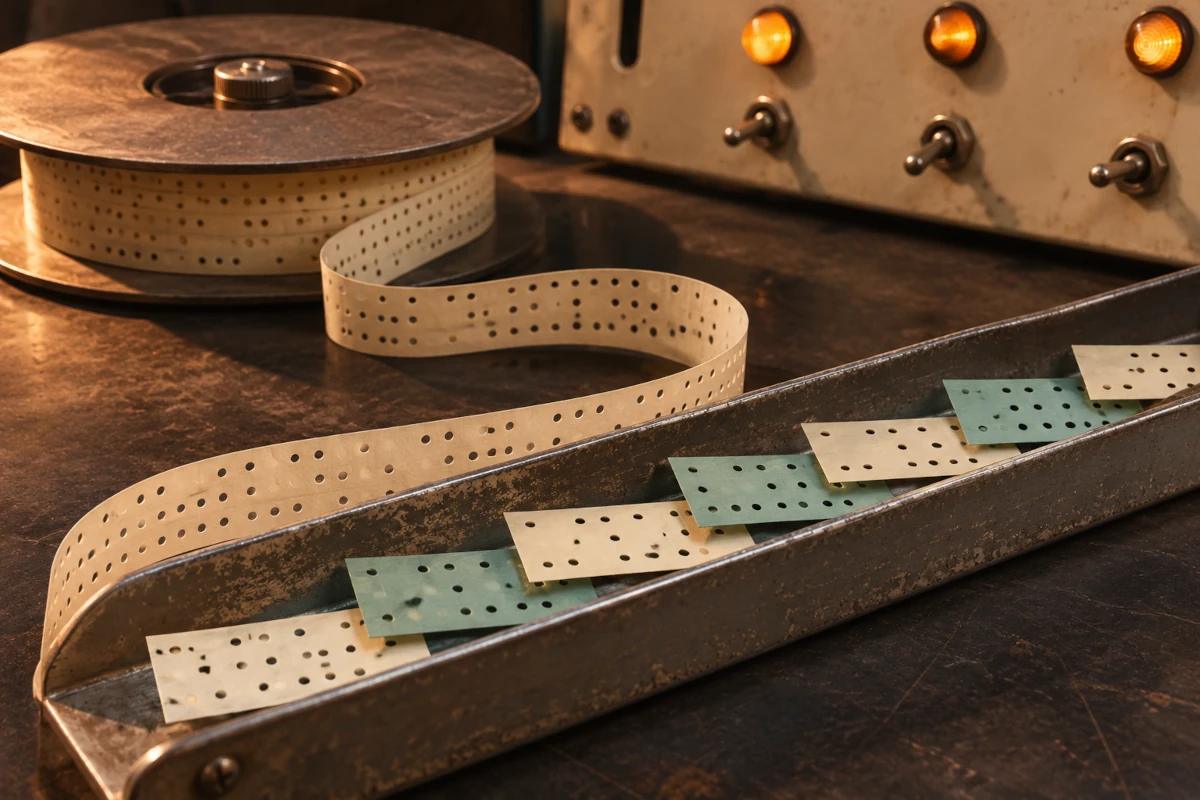
A person at a computer terminal types a command, waits for an answer, and pauses to think. The connection stays open through the silence. Multiply that pattern by hundreds of users and you have an expensive problem: a communications system reserving capacity for conversations that spend much of their time saying nothing.
The NPL network, developed at Britain’s National Physical Laboratory, grew out of a different idea. Let computers share communications capacity in small pieces. A user who has something to send gets a turn; a user who is thinking doesn’t need to hold the channel.
Donald Davies and his colleagues helped turn that idea into packet switching—and then into a working network.
The NPL network began with an awkward kind of silence
In a 1988 interview, Davies traced his thinking back to discussions about time-sharing computers in 1965. Time-sharing let several users interact with a computer rather than submit a job and wait for a later batch of results. But reaching that computer through a telephone connection presented another sharing problem.
Davies recalled hearing about long calls that carried surprisingly little data. A few bits would pass, followed by a pause. He began considering short messages that switching machines could store briefly and forward, rather than reserving bandwidth throughout the conversation. [1]
The concern was response time. Would stopping to store data at each switching point make an interactive system too slow? Davies reasoned that short units and sufficiently fast links could keep that delay small. [1]
This was an engineering question with an economic consequence: could many irregular conversations share infrastructure efficiently and still feel responsive?
Give the short message a turn
Imagine one output link serving two users. One wants to send a long block of data. The other has a tiny interactive request.
For a simplified example, assume a 1 Mbit/s link, a 16,000-bit transfer, and a 1,000-bit interactive message arriving just as the larger transfer starts. Ignore headers, processing, and other traffic.
| How the output is served | Current unit’s transmission time | Opportunity for the small message |
|---|---|---|
| Send the entire 16,000-bit transfer as one uninterrupted unit | 16 ms | It can start after the whole unit. |
| Split the transfer into 1,000-bit units | 1 ms per unit | It can start after the first unit, if selected next. |
The larger transfer hasn’t become shorter. Splitting it creates places where the switch can give someone else a turn. This is a teaching example, not a measurement of the NPL equipment.
A circuit-switched system solves the allocation problem differently: it reserves communications resources for an established circuit. That needn’t mean one physical wire belongs to one user; several circuits can share a physical link through fixed allocations. But a circuit’s reserved capacity is committed while the circuit exists.
With packet switching, traffic can share a link as demand arrives. Addressing information lets the switching system direct each unit toward its destination. The network must now manage queues, scheduling, and finite storage.
Small packets don’t guarantee small delays. If enough users send at once, they still wait. Headers and switching work also have a cost. The useful change is the opportunity to interleave traffic, instead of requiring a long transfer to remain one indivisible block.
From a national proposal to a working laboratory network
Davies’ ambition went beyond connecting a few machines in one building. His archive lists a proposal for a national communications service for online data processing dated December 15, 1965, followed by a digital-network proposal in June 1966. [2]
The team also published its design work. A paper by D. W. Davies, K. A. Bartlett, R. A. Scantlebury, and P. T. Wilkinson appeared at the 1967 ACM Symposium on Operating System Principles in Gatlinburg, Tennessee. Its title emphasized the objective of rapid responses at remote terminals. [3]
The national ambition didn’t immediately become a nationwide public service. NPL built a smaller network on its own site. Its Mark I implementation used a Honeywell DDP-516 minicomputer as a packet switch, with 768 kbit/s channels, and was operational by 1970. A practitioner history hosted by NPL documents this move from proposal to implementation. [4]
That single switch is a useful detail. A packet network doesn’t have to begin as a web of alternative routes. Packet switching describes the treatment and sharing of traffic; the topology determines which paths actually exist.
The NPL project was both an experiment and a service people could use. NPL’s timeline records online services for approximately 200 users in 1970. [5]
The 1967 meeting that carried the idea across the Atlantic
At the Gatlinburg conference, Roger Scantlebury discussed the NPL work with Larry Roberts, who was developing the plan for ARPANET.
The Internet Society’s history, coauthored by participants including Roberts, Vint Cerf, and Bob Kahn, describes that exchange. Scantlebury also pointed Roberts toward Paul Baran’s work at RAND. The account credits NPL with the word packet and connects the discussions to an increase in the proposed ARPANET line rate from 2.4 kbit/s to 50 kbit/s. [6]
This is a more useful picture of invention than one finished blueprint passing from a single inventor to everyone else. Researchers had different objectives, published designs, compared assumptions, and changed their plans.
Roberts and the ARPANET builders still had an enormous implementation task ahead. NPL’s contribution was part of that exchange, alongside independent work elsewhere.
| Date | Milestone | What it tells us |
|---|---|---|
| 1965 | Davies develops his approach and proposes a national data service. [1, 2] | The concept predates the working NPL network. |
| 1966 | A digital-network proposal is documented in Davies’ archive. [2] | The idea becomes a design program. |
| 1967 | The NPL team presents its paper at Gatlinburg; Scantlebury exchanges ideas with Roberts. [3, 6] | Research communities compare their approaches. |
| By 1970 | The local NPL network is operational. [4, 5] | Packet switching becomes working infrastructure at the laboratory. |
NPL, RAND, and ARPANET had different starting points
Paul Baran’s work at RAND explored distributed communications. His 1964 report described a system intended to operate without a vulnerable central control point and examined how a distributed network could carry digital information. [7]
Davies’ route into the subject centered on efficient, responsive computer communication. ARPANET’s early purpose included sharing computing resources among research sites. These projects informed one another, but their motivations and designs shouldn’t be collapsed into one story.
The Internet Society’s account explicitly distinguishes ARPANET from the widespread claim that it was originally a network designed to survive nuclear war. That survivability concern belonged to Baran’s RAND research; it wasn’t the reason ARPANET itself was commissioned. [6]
The distinction also matters technically. The NPL Mark I’s single switch illustrates packet sharing without a distributed mesh. A resilient topology and packet switching can work together, but one doesn’t automatically supply the other.
For the wider context, our history of networking in the 1970s follows the development of several technologies that would eventually coexist in modern networks.
What the experiment explains about today’s networks
When a voice call competes with a backup, the problem Davies cared about is still recognizable. Both generate data, but the consequences of making them wait are different. Dividing traffic into packets gives the equipment opportunities to choose what to send next.
It doesn’t settle how those choices should be made. A queue can remain full, a scheduler can favor one class of traffic, and an application’s deadline can pass while its data waits. Modern congestion control and traffic scheduling address problems that sharing creates.
Nor was the original NPL network simply today’s Internet in miniature. Packet switching is one building block. Connecting independently designed networks, defining common addressing and transport behavior, and deploying those protocols required further work.
What NPL helped establish was a practical answer to a deceptively ordinary observation: computer conversations contain pauses. Instead of treating those pauses as reserved capacity, a network could use them to carry someone else’s message.
Sources and further reading
- 1. Donald Davies — interview with James L. Pelkey, recorded May 27, 1988; Computer History Museum transcript
- 2. Catalogue of the papers of Donald Watts Davies — Centre for Scientific Archives, especially entries C.26–C.29
- 3. Davies, Bartlett, Scantlebury, and Wilkinson — A Digital Communication Network for Computers Giving Rapid Response at Remote Terminals, ACM SOSP, 1967
- 4. Packet Switching: The First Steps on the Road to the Information Society — practitioner history hosted by NPL
- 5. National Physical Laboratory — historical timeline
- 6. Leiner et al. — A Brief History of the Internet, Internet Society
- 7. Paul Baran — On Distributed Communications, Volume I, RAND, 1964