
Imagine trying to repair a calculation without opening up the information you are trying to protect. That is one of quantum computing’s strangest engineering challenges. Measuring the data in the wrong way changes its quantum state. Meanwhile, errors keep arriving.
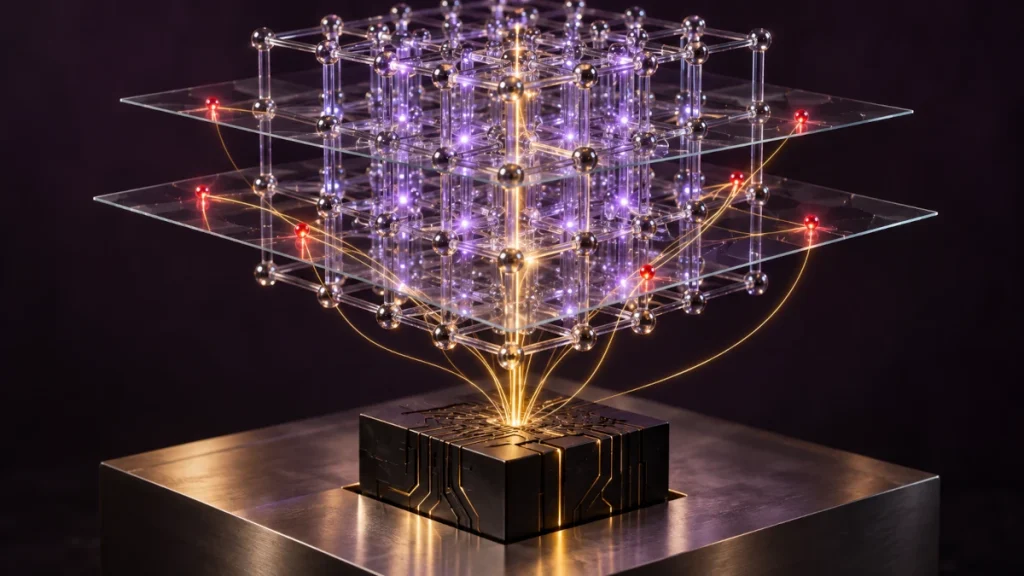
The machine needs clues. Then it needs someone to interpret them.
That second job is becoming an intriguing application of artificial intelligence. AI for quantum error correction uses neural networks running on classical hardware to interpret error-checking measurements. The aim is to help a quantum processor preserve its calculations, sometimes under deadlines measured in fractions of a microsecond.
Research published throughout 2026 is turning this into a concrete engineering story. A preprint released on 2 October explores neural decoding across different experiments on real superconducting hardware. On 14 October, QuEra published an industry perspective on why machine learning is becoming an important part of the decoding toolkit.
First, protect the information without copying it
A physical qubit is a hardware system used to hold quantum information. A logical qubit is information encoded across a group of physical qubits so that suitable errors can be detected and corrected. Quantum computing basics provide the background; the crucial distinction here is the encoding.
You cannot simply make three perfect backup copies of an arbitrary unknown quantum state. The no-cloning theorem rules that out. Quantum error correction instead distributes information across an encoded system and measures carefully chosen joint properties called stabilizers.
These checks reveal information about errors without revealing the protected logical state. Auxiliary qubits often help extract the measurements. IBM’s introduction to error correction explains the mechanism.
The resulting collection of check outcomes is an error syndrome. With repeated checks, the decoder receives a history of measurements, including changes over time. Its task is to infer a suitable correction from those clues.
The syndrome is a detective’s notebook
Consider a deliberately classical toy example. Three bits should agree. A check says the first and second disagree; another says the second and third disagree. If you assume exactly one bit flipped, the middle bit is the suspect. You learned something useful by checking relationships.
Quantum codes are more demanding: they must handle phase errors as well as bit flips, and the checking measurements themselves can be faulty. A pattern appearing across several rounds might have more than one explanation.
Importantly, a decoder does not always need to reconstruct the unique physical history. Different error patterns can have the same harmless effect on the encoded information. The goal is a recovery that preserves the logical state. IBM’s treatment of stabilizer codes describes why a syndrome does not generally identify a unique error.
This creates a demanding pattern-recognition problem: which explanation of the evidence leads to a successful recovery?
Why neural networks are getting the job
Real hardware has habits. Some errors are correlated; a measurement can be ambiguous; a qubit can leak outside the states intended for computation. A learned decoder can exploit patterns in the measurement record and the noise it was trained to recognize.
In November 2024, the peer-reviewed AlphaQubit study in Nature demonstrated a recurrent neural decoder combining transformer-based processing with memory across correction rounds. It was trained using simulated data and fine-tuned with experimental data from Google’s Sycamore processor, outperforming the comparison decoders on the tested experimental datasets.
That result established a powerful possibility: better software could extract a better logical outcome from the same measurements. But the original AlphaQubit was too slow for real-time correction on fast superconducting processors, as Google’s accompanying explanation made clear.
For readers familiar with deep learning, this is a specialized inference task. The model consumes numerical measurement records and produces decoding decisions. Its success is judged by whether the protected computation survives.
What has changed in 2026?
The research now addresses practical questions about speed, integration, and adaptability. These examples answer different questions; they are not a league table.
| Research | What the authors report | What the result establishes |
|---|---|---|
| FPGA neural decoder, preprint submitted 6 May 2026 | Real-time correction on a distance-3 surface code using 17 physical qubits, with a 550 ns feedback-loop latency | A small neural decoder integrated with actual quantum control hardware |
| Modular neural decoder, preprint submitted 2 October 2026 | Tests on real superconducting hardware covering memory, stability, and a logical parity-measurement operation | Evidence of adaptability beyond one memory benchmark; this work does not demonstrate real-time streaming operation |
The May study separates 124 ns of neural decoding from 550 ns for the measured feedback loop, timed from the end of readout pulses to the start of feedback pulses. Its correction cycle was 1.25 microseconds. Those distinctions matter: a fast model is one component of a control system.
The October study uses reusable local encoders and hardware fine-tuning. Its experiments include a lattice-surgery merge, an operation used to measure a joint logical property. The authors explicitly distinguish an architecture compatible with real-time operation from a demonstration that it actually operates that way.
Both papers are cited here as preprints, rather than presented as peer-reviewed results.
A decoder has to keep up with the evidence
Think of a security camera producing footage faster than an investigator can review it. Even an excellent investigator eventually faces a growing backlog.
Quantum decoding has a similar distinction between throughput, the rate at which measurement data is processed, and latency, the delay before a particular decision becomes available. Some superconducting processors generate new check rounds roughly every microsecond. Classical processing must keep pace, and decisions must arrive in time for operations that depend on them.
Not every correction requires an immediate physical pulse. Some can be tracked in a classical record called a Pauli frame, with later operations or measurements interpreted accordingly. The required feedback timing depends on the computation and control architecture.
AI can also share the workload with established algorithms. NVIDIA’s April 2026 pre-decoder research describes a modular pipeline: a neural stage handles local patterns before passing the remaining syndrome information to a global decoder. This is a practical way to combine learned inference with existing decoding methods.
Four questions that make a quantum headline more useful
- Was it tested on hardware or simulated noise? Both are valuable, but they establish different things.
- Was the decoding offline or integrated into the running control system? An accurate retrospective analysis does not demonstrate timely feedback.
- What scale and operation were tested? Protecting a small quantum memory differs from supporting many logical qubits through a long algorithm.
- How robust is it when the noise changes? A model trained on yesterday’s device still needs validation on today’s conditions.
QuEra’s 14 October discussion highlights both the promise of learned and hierarchical decoders and the continuing problem of distribution shift. It is an industry perspective, not a new experimental demonstration of its own.
A better decoder cannot compensate for arbitrary hardware noise or, by itself, deliver a useful fault-tolerant computer. Reliable logical operations, scalable control, and the rest of the system still have to work together.
Yet this is an unusually compelling meeting of AI and quantum engineering: a classical machine learns to interpret the clues left by fragile quantum information, helping that information survive long enough to become useful.